Book Club
Reading one of the Shadow & Subterfuge novels with your book club? These guides are free to use.
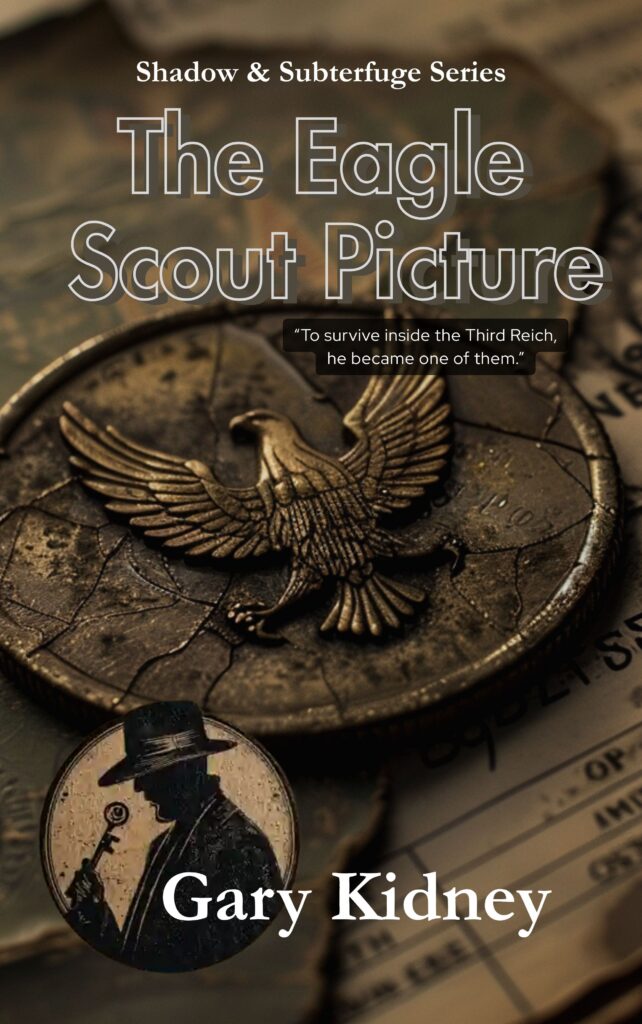
The Eagle Scout Picture — Discussion Guide
For reading groups
In May 1940, Fred Brown — a farm boy from the German-speaking community of Fredericksburg, Texas — is recruited straight out of high school. In February 1941 he crosses into the Third Reich at the Brenner Pass as Frederich “Zelly” Zellner, a Hitler Youth sergeant whose job is to burrow into the SS as America’s mole. The rule he is given: “Fit in… or die.” Questions marked (spoiler) give away late events; groups still reading may want to stop before them.
Discussion questions
- Eleven minutes into the Reich, at the Brenner Pass, a Gestapo officer orders Zelly to stomp on a Jewish baby. He can’t make his boot come down, and the officer fires instead. Later an inner voice says, “You should have stomped on the baby’s head.” What did his refusal cost him, and what did it save? What would you have done?
- In the Hitler Youth headquarters lobby, Zelly finds his own Eagle Scout Court of Honor photo on the cover of a 1938 Hilf mit!, taken by his Scoutmaster when he was fifteen. Later it hangs framed on the Zellners’ parlor wall in Wittenberg. Why name the novel after this photograph rather than the rockets or the mission? How does its meaning change each time it appears?
- Dr. Otto’s advice, passed on by Vinny: “Lock Fred away, and don’t release him until you reach home. Be Zelly, always.” The novel gives Zelly’s thoughts as two italic voices, often a question and a rebuke. How did the two voices affect your reading? Did you always know which one was Fred?
- At his Adlon Hotel window, Zelly feels for the first time that he belongs. He loves the Hitler Youth song he first heard in training in San Antonio. One voice warns, “You’re not fitting in. You’re joining them.” What makes Nazi Germany attractive to this eighteen-year-old, and why didn’t the author make him simply repelled by it?
- Some chapters are told from inside Gestapo agent Oskar Stengler’s head. His suspicion begins with one gap: he once taught at the Wittenberg Gymnasium and can’t remember teaching this boy. How did knowing the hunter’s thoughts change the suspense? Did Stengler ever become more than a villain?
- Right after Peter Unger’s death at Wolfstein, the book drops back to a five-day stopover in Belfast with Meg and Fergus McAuley, where Fergus works out the mission because Zelly talks German in his sleep, and Vinny beats Zelly for confirming it. Why place that episode there? (spoiler) At Uelzen in April 1945, the very slip Vinny feared saves Zelly’s life. What does the book say about trust and rule-breaking in spy work?
- At Peenemünde, Zelly does his rocket work well enough to win trust and promotion, and watches the 3 October 1942 launch reach space. His conscience: “You couldn’t stomp a baby but enabled rockets to destroy London.” Can a spy do this kind of job halfway? How did you weigh his pride in the rocket against its purpose?
- (spoiler) Zelly has fed the Allies information about the base, including a map. Then the British raid of 17 August 1943 kills Trudl and Helmut. How does the novel handle the fact that his success as a spy helped kill people he knew and cared about?
- (spoiler) In the Wittenberg barn, Aunt Freida tells him, “Frederich bore the mark of Abraham’s covenant,” and Zelly understands his own family is Jewish. Go back to Dr. Otto’s “We are what Hitler fears most—an international conspiracy of Jews” and to the voice in Berlin that called the murdered baby a cockroach. How does the revelation change how you read his earlier choices?
- (spoiler) At Zement, Zelly creates the Ebensee camp to supply labor. He never abuses or kills a prisoner and sabotages the project so it never opens — yet eight thousand people, mostly Jews, die under his command, and he later finds his name in a ledger: “Accessory to mass murder, at large.” One voice says “I followed orders”; the other, “You’re a criminal.” Which do you believe? Does his sabotage change the answer?
- (spoiler) At Remagen, an Army psychologist diagnoses “a dissociative and multiple personality disorder, possibly schizophrenia” and recommends indefinite detention. Fred and Zelly argue their case to General Sibert together: “If I suffer from a dissociative personality disorder, it seems the U.S. Army bears the fault.” Is he right? What does a nation owe the people it asks to become someone else?
- (spoiler) In the Fredericksburg kitchen, Da collapses at Fred’s feet: “I offered them my only son.” Fred answers that he now understands how much his father cherishes America. Was that the answer you expected? Could you forgive him — or, as a parent, have made that offer?
Going further
- Peenemünde and the August 1943 raid. Read about the Peenemünde research center, the A-4 (V-2) rocket and the British raid of 17 August 1943. The author’s note says the official history credits fishermen with reporting Peenemünde’s importance, while Józef Garliński’s Hitler’s Last Weapons (1978) credits Polish partisans. Compare both with the novel’s Boryslaw, Arek and Radzim.
- Hilf mit! was the magazine of the Nazi teachers’ league. Look at how Nazi publications for teachers and children used images of the “ideal” German boy, and discuss why a Texas Eagle Scout could pass as one.
- From Peenemünde to Houston. The epilogue puts Zelly in the crowd at Rice University on 12 September 1962 for Kennedy’s “We choose to go to the moon” speech, with Wernher von Braun and other Peenemünde engineers present. Read about Operation Paperclip and discuss what it means that America recruited the men Zelly spied on.
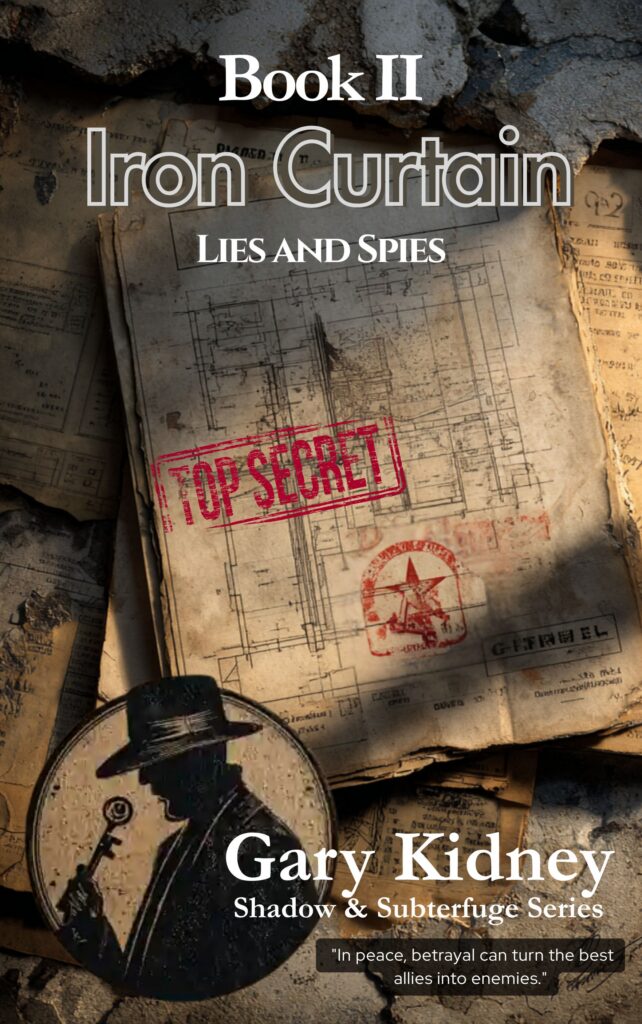
Iron Curtain Lies and Spies — Discussion Guide
Content note: contains scenes of sexual content and torture.
For reading groups
The novel opens on Sunday, 7 July 1946. Fred Brown has been home in Fredericksburg for eleven months after five years undercover in Nazi Germany as SS officer Zelly Zellner — an identity that now shares his mind. Three men from Washington walk into his church and send him back to a Europe divided between the Allies and the Soviets, this time as deliberate bait, carrying three files marked Ratline, Bomb and Hitler. The book stands on its own but follows The Eagle Scout Picture.
Discussion questions
- Under the oak outside Holy Ghost Lutheran, Fred learns Washington will leak his arrival on purpose to flush out a double agent. Donovan admits, “When I recruited you, I never expected you to survive.” Fred now has a wife and a young son. Why does he say yes — and would you?
- The book opens with Churchill’s “iron curtain” line of 5 March 1946 and Hoda Kotb’s warning: “Be careful who you pretend to be. You might forget who you are.” Which describes the novel better? Whose lies do the most damage?
- In Berlin, Fred finds a citation in his own SS file awarding him an Iron Cross, Second Class, for uncovering saboteurs at Peenemünde — an honor he never knew about. “I’ll bet I’m the only American who has ever received one.” Later he wins over Nazis with Himmler’s silver medallion and his Hilf mit! cover. What does it mean that his best credentials are also the strongest evidence against him?
- The novel cuts between Zelly and SMERSH officer Kirya Makarova, whose standing order is “recruit, retain, or rub out.” How did seeing the hunt from her side change how you felt about her? Did her contradictory stories about her past make you trust her less, or understand her more?
- Werner Fischer, a Führerbunker runner once decorated by Hitler, says, “I’m regretful of being in the HJ, but I’m still German and love my country.” When Artur Axmann says a living Hitler would mean “a hope for a new Reich,” Werner answers, “And I would hate it.” What does the book suggest about how young Germans let go of what they were raised on — and why is it Werner, not the American, who breaks Axmann?
- In the Harz Mountains, Zelly lures Kirya’s squad into an ambush by wehrwolf boys under a former SS officer; three Soviet soldiers die. Afterward he denies any part in it — the two nations are allies. Was the ambush justified? What does it say about the alliance in summer 1946?
- After his night with Kirya at Ohrdruf, the voices argue: Zelly calls it survival; Fred answers, “You enjoyed it too much” and “I must be your conscience.” Do Fred and Zelly work together in this book, or pull against each other?
- Gehlen asks a question the book never fully answers: “Why did they send you? … Perhaps they wanted you discovered.” Kirya reminds him that the Allies sent troops into Russia after the First World War: “Because you haven’t learned history doesn’t make it false.” Where does the novel suggest Cold War mistrust began?
- Under truth serum in Munich, three voices answer Kirya: “‘A mechanical computer,’ Don said. ‘Electrical signals,’ Fred said. ‘Predicate logic,’ Zelly said.” In Vienna, Zelly survives an interrogation by reciting Jabberwocky while his captors write it down. How does humor work in scenes of real danger? Is “Don Richardson” a third person, or only a cover?
- (spoiler) Elf asks what he would do if someone murdered his family: “I’d get revenge, naturally.” Instead he escorts Kammler to Argentina, moves the rocketry fortune into his own account, hands Kammler to the Chilean police, and accepts a 10% finder’s fee on money he himself calls “stolen or from Jewish property.” Did he keep faith with Elf? Should he have kept the fee?
- (spoiler) Two confessions: in Rome, as “Vincente,” he tells Don Marco “Lying is my worst sin” — lying as he says it; in Curaçao he confesses his infidelity to Meg. Why put both in one book? Which costs him more, and which brings real forgiveness?
- (spoiler) In the Genoa tavern, minutes before she dies, Kirya tells him “Stalin’s goal is to achieve parity, but it doesn’t require you,” then asks, “Which identity resonates more—American or German?” Zelly admits it “has been puzzling me for years.” How would you answer for him by the last page? How did her death change your view of her?
Going further
- Operation Osoaviakhim. The author’s note describes the Soviet program that forcibly moved more than 2,500 German scientists and engineers, with their families, to the USSR. Look up Helmut Gröttrup (chapters 12–13), then reread the Nordhausen scene and the epilogue.
- The Vatican ratline. Chapters 21–23 follow the Italian escape route, including Bishop Alois Hudal at Santa Maria dell’Anima. Read about Hudal, Die Spinne and Stille Hilfe, and compare the history with Don Marco’s explanation in chapter 21.
- Farm Hall and the German bomb. In 1945 the British secretly recorded ten captured German nuclear scientists, Heisenberg among them. The author’s note says plainly that the novel’s German atomic test goes against the usual historical conclusions and cites Rainer Karlsch’s Hitlers Bombe (2005). Read about the transcripts and the debate, and decide which side convinces you.
© 2026 Gary Kidney. All rights reserved. Data submitted via our contact form is never stored unless you explicitly opt-in to our Constant Contact newsletter. This site uses Google Analytics and Microsoft Clarity, which set cookies to count visits and see how pages are used. Clarity hides anything you type. Your data is never sold or shared.