Shadow and Subterfuge Series
Historical Archives
The Leap from East 61st Street:
Oksana Kasenkina and the Summer of 1948
by Gary Kidney
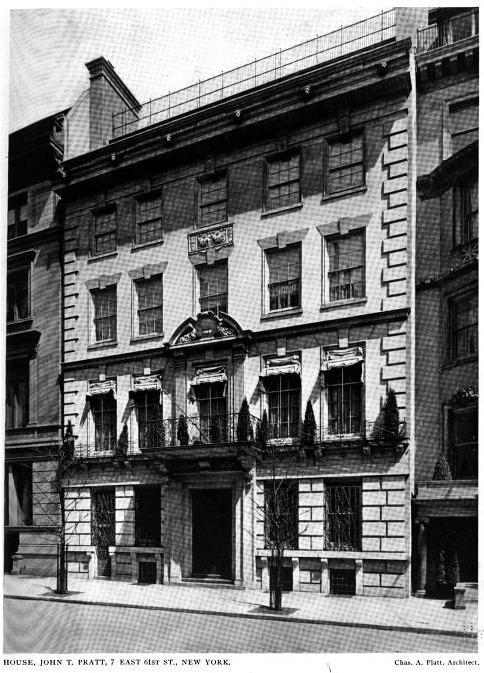
The Soviet Consulate General, 7 East 61st Street, photographed in 1917 as the Pratt house. From Architecture, 1917; public domain.
These days, Russians seem to fall out of tall windows quite frequently. I chuckled when I first encountered the story of a Soviet lady who tumbled from a third-floor window in Manhattan, not because the story wasn't sad but because I wondered if Oksana Kasenkina was the model for future KGB disposals. Here's the story.
———
At about twenty past four on the afternoon of 12 August 1948, a woman climbed out of a third-floor window of a townhouse on East 61st Street in Manhattan and let go.
She landed in the paved yard below, broke her right leg in several places, suffered internal injuries, and lived. Within minutes New York police were in the yard. Within hours she was in Roosevelt Hospital with detectives at the door. Within two weeks the President of the United States had expelled a senior Soviet diplomat, Moscow had closed its consulates in America, and the two superpowers had stopped speaking to each other through consuls for more than twenty years.
The townhouse was the Soviet Consulate General. The woman was Oksana Kasenkina, a fifty-two-year-old chemistry teacher. And almost everything about why she jumped is still argued over.
A SCHOOL THAT WAS CLOSING
In the summer of 1948 the Cold War was no longer a figure of speech. The Soviets had sealed the land routes into West Berlin in June; American and British planes were flying in coal and flour. In New York, Moscow was quietly pulling its people home. The small school that taught the children of Soviet diplomats was closed on orders from Moscow, and its teachers were booked to sail for the USSR on the liner Pobeda on 31 July.
When the Pobeda sailed, two of the teachers were not aboard. One was the former headmaster, Mikhail Samarin, who had disappeared with his wife and three children and would soon ask the FBI for asylum. The other was Kasenkina, a widow from Ukraine whose husband had been taken by the NKVD in 1937 and never came back.
THE FARM
She had gone to the Russian-language newspaper that most annoyed the Soviet government, and from there she was driven up the Hudson to Reed Farm at Valley Cottage, a refuge run by the Tolstoy Foundation. Its president was Countess Alexandra Tolstaya, the youngest daughter of the author of War and Peace, who had left the Soviet Union and spent the rest of her life helping others do the same.
The farm was full of Russian exiles, many of whom had fought the Bolsheviks and some of whom had served alongside the Germans, and none of whom trusted a Soviet schoolteacher who arrived with no story they could check. She worked in the kitchen. She was lonely and frightened. After five days she smuggled out a letter to the Soviet Consul General, Jacob Lomakin, begging him not to let her perish there.
On 7 August Lomakin drove up in a black car with his vice consul and collected her. Tolstaya had her men surround the car, took Kasenkina into the house, and argued with her. Kasenkina insisted on going. The countess let her go.
KIDNAPPED BY WHOM?
That evening Lomakin gave the New York press a remarkable show. He produced Kasenkina, who told the reporters she had been drugged and carried off by White Russian bandits, and he read from her letter. The Soviet embassy lodged a formal protest with the State Department, accusing the Tolstoy Foundation of abducting two Soviet citizens.
The American press drew exactly the opposite conclusion. To them the teacher had been snatched back from freedom and was now a prisoner of the consulate. Crowds and cameras camped outside the building on East 61st Street. A New York judge, Samuel Dickstein, signed a writ of habeas corpus ordering the Consul General to bring Kasenkina into court. Lomakin replied that he had no power to compel a free Soviet citizen to appear anywhere, and that she was ill.
The writ was due to be answered on 12 August. That afternoon she went out of the window.
A WINDOW, AND TWO STORIES
What she was running from depends on which account you read, and she gave more than one.
The version the world heard came quickly. From her hospital bed, surrounded by police and the anti-Soviet exiles now allowed to visit her, she was the woman who had leapt to freedom rather than be shipped back to Stalin. A year later she published a memoir under exactly that title, Leap to Freedom, written with the help of a veteran anti-communist journalist. American radio carried the story into the Soviet Union in language after language.
The other version is quieter and sadder. Her earliest words to the police, and the letters she wrote before and after the farm, describe despair rather than a plan: a woman who did not trust the Soviets, did not trust the exiles, did not know where she belonged, and was caught between the two in the most public way imaginable. Some historians now read the jump as that of someone who had simply run out of places to stand.
Both versions can be true at once. That may be the most honest thing to say about her.
THE PRICE OF A WINDOW
Whatever her motive, the consequences were immediate. The State Department decided that Lomakin had held a woman against her will on American soil, and on 19 August President Truman approved revoking his exequatur, the document that allows a foreign consul to do his job. For a diplomat of his rank, it was a rare and pointed act.
Moscow answered within days. It closed its consulates in New York and San Francisco and required the United States to close its consulate in Vladivostok, its only diplomatic outpost on the Soviet Pacific coast. Consular relations between the two countries did not resume until the early 1970s.
Kasenkina stayed. She recovered slowly, received permanent residence, became an American citizen in 1956, and died in Miami in 1960, largely forgotten by the country whose front pages she had filled.
WHY IT MATTERS
The Cold War is usually told through bombs, blockades and spies. The Kasenkina affair was none of those. It was a frightened teacher, a closing school, a farm full of exiles, a consul who staged a press conference, a judge with a writ, and a window. In a summer when the two sides were looking for proof of what the other really was, a woman who fitted neither story became the proof that both of them needed.
One afternoon on East 61st Street, one person made one decision, and two governments spent the next two decades living with it.
———
Gary Kidney writes the Shadow & Subterfuge series of historical espionage thrillers, in which a Texas farm boy lives inside borrowed identities on both sides of the early Cold War, and learns what it costs when two governments both claim to own the truth about a person.
© 2026 Gary Kidney. All rights reserved. Data submitted via our contact form is never stored unless you explicitly opt-in to our Constant Contact newsletter. This site uses Google Analytics and Microsoft Clarity, which set cookies to count visits and see how pages are used. Clarity hides anything you type. Your data is never sold or shared.