Shadow and Subterfuge Series
Historical Archives
Operation Osoaviakhim:
The Night the Soviets Took Their Germans
by Gary Kidney
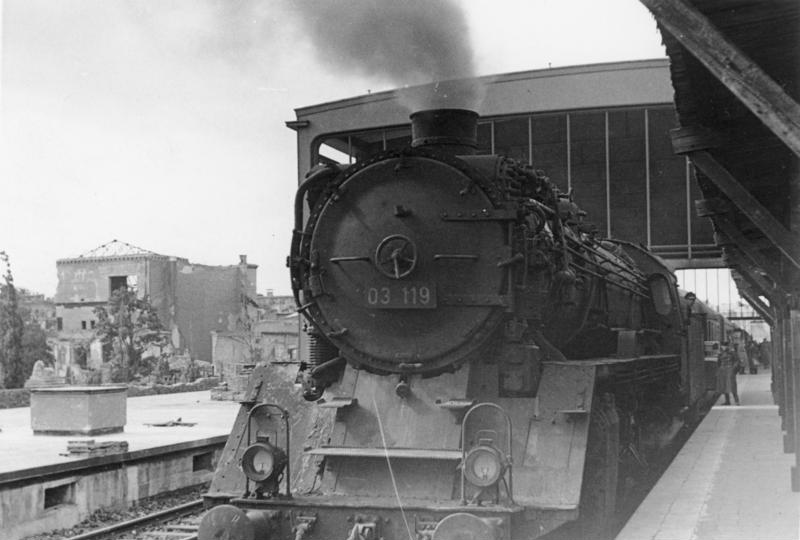
Berlin, 1946. The Berlin–Halle express leaves Bahnhof Zoo as long-distance rail traffic resumes. Bundesarchiv, Bild 183-1992-0122-503 / CC-BY-SA 3.0
Before dawn on 22 October 1946, Soviet officers, interpreters, and armed soldiers began knocking on doors across the Soviet occupation zone of Germany. The people inside were not being arrested for a crime, at least not in the ordinary sense. They were engineers, scientists, designers, technicians, and skilled industrial workers. They were told to pack. Their families were coming too.
Within hours, trucks carried them to railway stations. Trains took them east into the Soviet Union. The operation was secret, highly coordinated, and vast: roughly 2,500 specialists and around 4,000 family members were transferred, a total of more than 6,000 people by one widely used estimate. The Germans gave the episode a name that stuck: Aktion Ossawakim, usually rendered in English as Operation Osoaviakhim. The name was borrowed from a Soviet mass organization — the Society for the Assistance of Defense, Aviation and Chemical Construction, which had recruited civilian specialists for the Red Army. The deportation was named, in other words, after a civil-defense club.
It is one of the strangest, least remembered episodes of the early Cold War. Operation Paperclip — the American program that brought German scientists and engineers to the United States — is embedded in the popular history of rockets, the Moon landing, and Wernher von Braun. Osoaviakhim is its darker, less familiar counterpart: not recruitment and immigration, however compromised and morally fraught those processes could be, but an overnight compulsory transfer of expertise, families, equipment, and industrial capacity.
The prize was not simply German knowledge. It was time.
THE SCRAMBLE FOR GERMAN SCIENCE
By 1946, the victorious powers were competing to seize the technological inheritance of the defeated Reich. German research had produced the V-2 ballistic missile, advanced jet aircraft, precision optics, chemical processes, submarine technology, and wartime industrial techniques. No victor wanted a rival to acquire the people who knew how those systems worked.
The United States had its own program. Project Paperclip was designed to identify, recruit, and bring German scientists and technologists to America. The program was expanded in 1946, despite concerns over the Nazi affiliations of many prospective recruits. It later supplied a famous strand of the American space story.
But the Soviet Union had suffered incomparably from the German invasion, and it understood technical expertise as both reparations and national security. Soviet planners had initially worked with German specialists in occupied Germany. In rocketry, Moscow created institutions to exploit the V-2 legacy; a May 1946 decree placed German specialists within the new Soviet missile-development system.
Then the policy changed. Rather than leave the expertise near a politically unstable frontier, the Kremlin would move it into the USSR — and move the laboratories with it.
A DEPORTATION DISGUISED AS AN ASSIGNMENT
The operation’s speed was part of its logic. Warning would have invited flight, concealment, or resistance. On 22 October, Soviet authorities removed specialists from aerospace, optics, chemistry, electrical engineering, armaments, and other strategically valuable fields. Entire company inventories and research equipment followed on freight trains.
The numbers vary according to whether one counts only the main October operation, people taken in earlier and later transfers, or family members. The clearest account is therefore not “thousands of scientists,” but thousands of specialists — scientists, engineers, technicians, and skilled workers — along with their families. A scholarly estimate puts the figure above 2,500 specialists and around 6,500 people in total, spread within weeks across some thirty Soviet industrial institutions.
That distinction matters. Osoaviakhim was not merely a raid for celebrity scientists. It was an attempt to transplant functioning technical ecosystems. A rocket designer is useful; so are the draftsmen, machinists, engine specialists, laboratory assistants, and families who make it possible for him to keep working.
The people taken were not all treated identically, and their circumstances were not reducible to a single image of forced labor. Many were housed with their families, paid, and assigned professional work. Some eventually spent years in comparatively comfortable, closely supervised research settlements. Yet the fundamental fact remained: they had not freely chosen the journey, could not control its destination, and could not simply leave.
THE ENGINEERS BEHIND THE IRON CURTAIN
The most consequential group included German rocket specialists. More than 200 German experts arrived at the Soviet missile institute NII-88, with nearly 500 people once families were counted. Some were sent to work on rocket engines; many others were settled on Gorodomlya Island in Lake Seliger, away from the principal Soviet design centers.
Their contribution to Soviet rocketry is easy to overstate and wrong to dismiss. The Soviet Union already possessed exceptional engineers, including Sergei Korolev and Valentin Glushko, and its missile and later space achievements were ultimately Soviet built. But German teams brought V-2 experience, documents, industrial methods, and a running start in fields where every year mattered.
The same applied beyond rocketry. Aircraft designers worked on jets and engines; optical specialists worked with precision instruments; chemists and industrial engineers helped fill gaps in Soviet production. Around 3,000 German specialists were transferred to the USSR between 1945 and 1947, many of them compulsorily moved.
Most returned to East Germany between 1950 and 1954; some not until the late 1950s.
WHY THE STORY DISAPPEARED
Osoaviakhim sits awkwardly in almost every national memory. It complicates the American story of Paperclip by showing that the postwar contest for German knowledge was not a uniquely Western project. It complicates Soviet triumphal narratives by revealing how extensively Moscow relied on captured and transferred German expertise. And it complicates German memory because some of those removed had worked for a regime that had devastated the Soviet Union.
The operation also vanished into the secrecy of the Cold War. The Soviet state had no interest in advertising dependence on Germans. Western audiences had little reason to learn the names of engineers working behind the Iron Curtain. The most visible symbols of the space race — Sputnik, Korolev, Gagarin, Apollo, von Braun — left little room for an episode involving trains, frightened families, and industrial specialists moved in the dark.
Yet Osoaviakhim matters precisely because it was not an anecdote. It shows the early Cold War as a race to appropriate not only territory and weapons, but human capability. The Soviet Union did not merely seize blueprints. It seized the people who could interpret the blueprints, rebuild the machinery, and teach the next generation.
On that October morning in 1946, the Cold War did not arrive with a spy plane or a missile launch. It arrived at the front door, before sunrise, with an interpreter, a soldier, and a few hours to pack.
———
Gary Kidney writes the Shadow & Subterfuge series. Book Two, Iron Curtain Lies and Spies, is set in the Germany of 1946 — the same year, the same scramble. A Texas farm boy is sent back under a false identity to find out what the Soviets were learning, and from whom.
© 2026 Gary Kidney. All rights reserved. Data submitted via our contact form is never stored unless you explicitly opt-in to our Constant Contact newsletter. This site uses Google Analytics and Microsoft Clarity, which set cookies to count visits and see how pages are used. Clarity hides anything you type. Your data is never sold or shared.